
Share:
Table Of Contents
Are Racing Arcade Machines Profitable? A 2026 Investor’s Guide to ROI and Market Trends
When entering the amusement industry or expanding a Family Entertainment Center (FEC), the most critical question for investors is: Are racing arcade machines profitable?
With rapid advancements in motion technology and immersive visuals, modern racing simulators have evolved from simple games into high-performance revenue engines. This guide breaks down the profitability of racing machines through market data, ROI calculations, and strategic operational insights for 2026.
Why Racing Machines Are Anchor Attractions
Racing games possess a unique “universal appeal” that spans all age groups. Unlike complex strategy games, racing is intuitive yet offers a high skill ceiling that keeps players coming back.
- The Immersive Edge: Professional force-feedback steering wheels, 4K triple-screen setups, and multi-axis motion platforms provide a physical experience that home gaming consoles simply cannot replicate.
- High Retention: Competition is the core of the arcade experience. When machines are linked for multiplayer races, a single play often turns into a “rematch session,” significantly increasing the average spend per head.
The Hard Math: Calculating Your ROI
How long does it take to get ROI? To help you make an informed investment decision, we have analyzed the average 2026 market performance to build this revenue model:
| Key Performance Indicator (KPI) | Estimated Data (USD) |
|---|---|
| Price Per Play | $2.00 - $5.00 |
| Average Game Duration | 3 - 5 Minutes |
| Peak Hourly Revenue | $24.00 - $60.00 (Per Unit) |
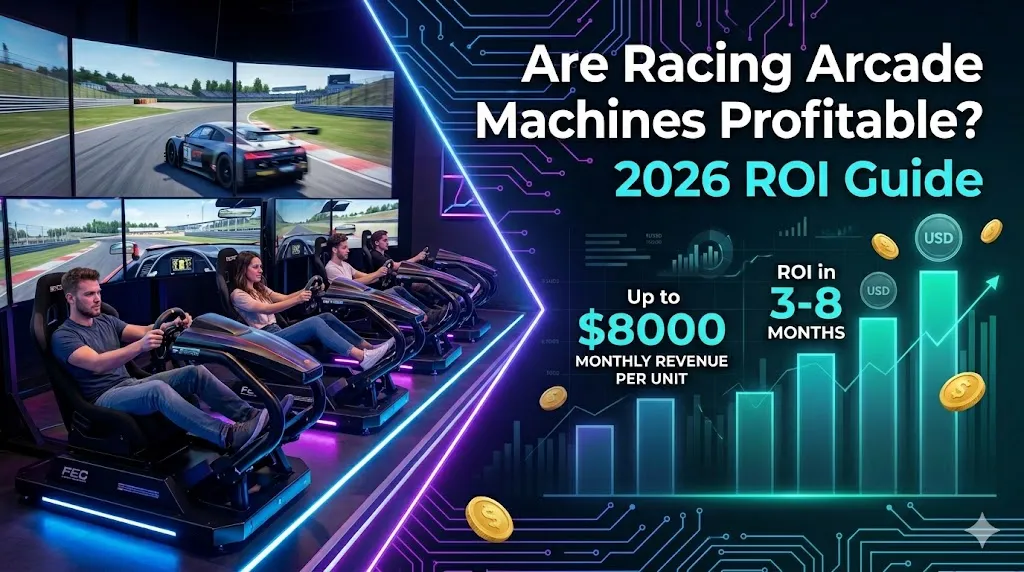
| Average Payback Period | 3 - 8 Months |
3 Strategic Ways to Maximize Profits
Success in the amusement business isn’t just about buying a machine; it’s about optimizing the environment.
A. The Power of Linkage
Data shows that racing units configured in pairs (2, 4, or 8 units) generate approximately 35% more revenue per machine than standalone units. The social atmosphere of a head-to-head race is a massive psychological trigger for repeat plays.
B. Direct-from-Factory & One-Stop Solutions
In the B2B world, controlling initial costs is the first step toward profit. By choosing a factory-direct partner (Such as Guangzhou FunSpace Technology Co., Ltd. ), you don’t just avoid middleman markups; you gain:
- Industrial-Grade Durability: High-quality motors and gears reduce “Downtime”—the biggest enemy of profitability.
- Professional Layout Planning: Expert guidance on floor plans to maximize “Revenue per Square Meter.”
C. Leveraging Tech Trends: VR and Motion
In 2026, players seek “Ultra-Sensory” experiences. Simulators equipped with VR headsets or high-DoF (Degrees of Freedom) motion bases can command price points 50% higher than standard arcade cabinets.
Conclusion: Is the Investment Worth It?
Are racing arcade machines profitable? The answer is a resounding yes. As a low-labor, high-turnover automated revenue tool, racing simulators remain a “greenfield” investment in the amusement sector. With stable hardware and a strategic location, these machines provide consistent, long-term cash flow.
Ready to Calculate Your Custom ROI?
If you are planning a new entertainment project, we provide comprehensive One-Stop Solutions from floor planning to equipment selection. As a leading manufacturer, we are dedicated to helping our global partners reach their profit goals faster.
If you want to learn more about racing arcade machines, you can browse this blog <Racing Arcade Machine Ultimate Guide (2026)>!
FAQ
On average, most operators achieve full ROI within 3 to 8 months. This timeline can be shortened by placing machines in high-traffic locations like malls or cinemas and utilizing multiplayer “linkage” setups to increase play frequency.
A single unit typically earns $50 to $300 per day during weekends and $1,500 to $8,000 per month in total revenue. Premium motion-based or VR racing simulators can generate significantly higher daily earnings due to higher per-play pricing.
The average monthly revenue fluctuates between $800 and $1,200 per machine in a standard FEC (Family Entertainment Center). Success depends heavily on “uptime”—choosing high-quality, factory-direct hardware is essential to avoid revenue loss from technical issues.
High-end machines generally offer a better long-term ROI. While “cheap” machines have lower entry costs, high-end simulators with motion feedback and high-quality graphics attract more repeat players and suffer less mechanical downtime, leading to higher overall profitability.
Commercial-grade machines are designed for a 3–8 year lifespan. Choosing a supplier that offers easy-access spare parts is vital for long-term ROI.
Beyond traditional arcades, high-traffic areas like cinema lobbies, shopping mall atriums, and even high-end Sports Bars are proven high-profit locations.
Send Us A Message