
Share:
Table Of Contents
Ultimate Guide to VR Arcade Machines
The Location-Based Entertainment (LBE) industry is undergoing a massive transformation, and virtual reality is leading the charge. For Family Entertainment Centers (FECs), arcades, and malls, virtual reality arcade machines are no longer a futuristic novelty—they are proven, high-yield revenue drivers.
Whether you are an established venue owner looking to upgrade your floor or an entrepreneur planning your first startup, this comprehensive guide will walk you through everything you need to know about commercial VR arcade machines in 2026.
What Are VR Arcade Machines?
How VR Arcade Machines Work
Unlike home setups, commercial VR game machine combine high-end VR headsets (like HTC Vive, Pico, or Valve Index) with dynamic motion platforms, haptic feedback systems, and specialized peripherals (like rifles or steering wheels). When a player puts on the headset, the motion platform moves in perfect synchronization with the visual data, tricking the inner ear and eliminating motion sickness while maximizing immersion.
Commercial VR vs. Home VR
Why do players pay for what they could theoretically experience at home? The answer lies in hardware scale and sensory immersion:
| Feature | Home VR | Commercial VR |
| Hardware | Standalone headset / Consumer PC | Heavy-duty industrial PCs, 3-6 DOF motion seats |
| Haptics | Hand controllers only | Wind, odor, heat, water spray, vibrating seat, force feedback peripherals, etc. |
| Space | Living room constraints | Dedicated free-roam arenas with tracked environments |
| Content | Consumer-grade games | Exclusive, high-throughput arcade versions (2–5 min sessions) |
Why Virtual Reality Arcade Machines Are Popular in FECs
Family Entertainment Centers love VR because it solves the ultimate arcade dilemma: maximizing revenue per square foot. VR entertainment equipment offer high throughput, repeat playability, and an incredible visual draw. Passersby see players screaming, dodging, and laughing, which serves as free, highly effective organic marketing on your venue floor.
Types of VR Arcade Machines
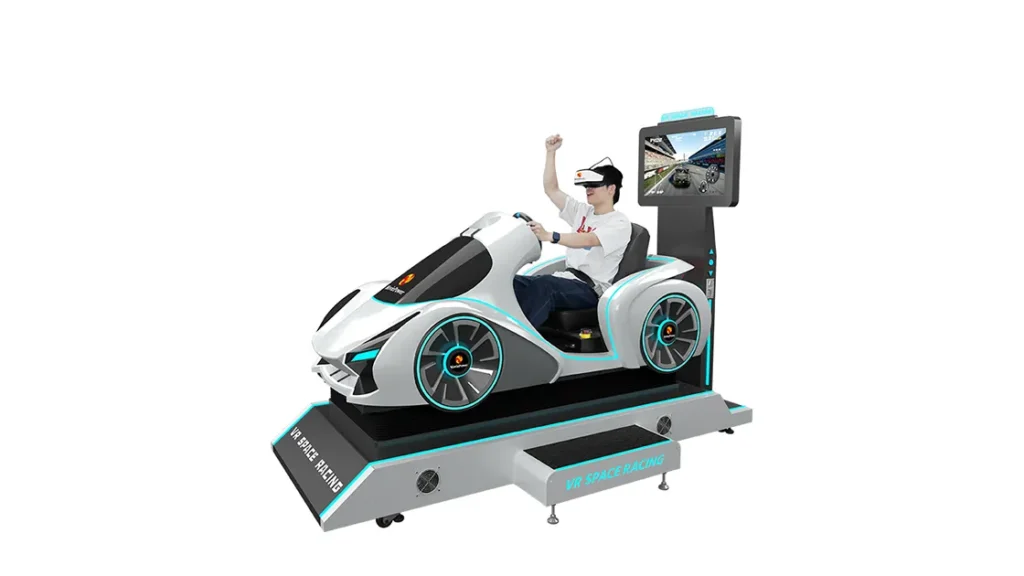
VR Racing Simulators
Equipped with force-feedback steering wheels, responsive gas/brake pedals, and multi-axis motion seats that tilt during sharp turns, VR racing simulators recreate the literal G-force of driving an F1 car or a supercar.
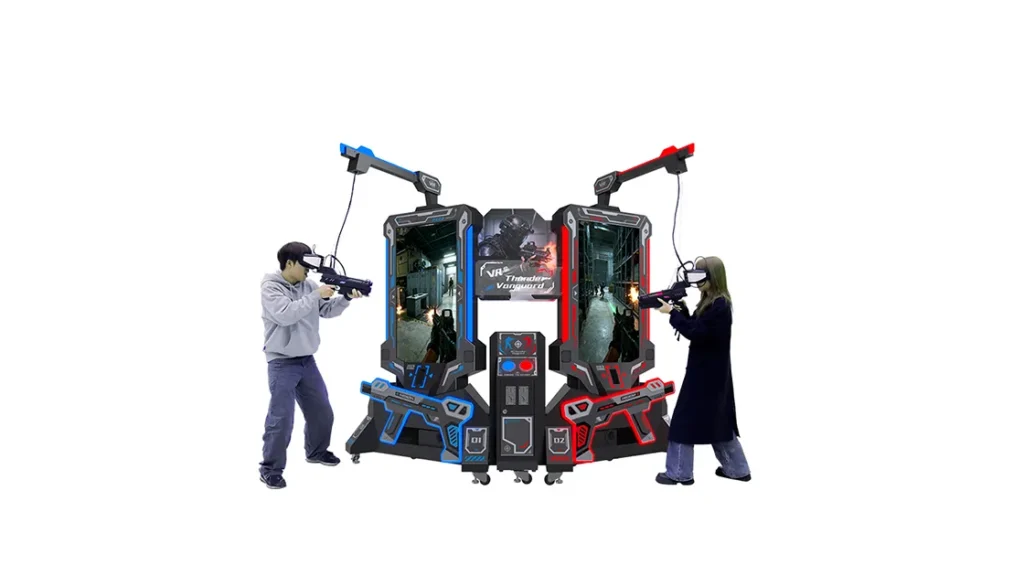
VR Shooting Simulators
These machines are typically equipped with a fixed platform and realistic haptic feedback firearms. Players must fight off waves of zombies, alien invasions, or military targets.
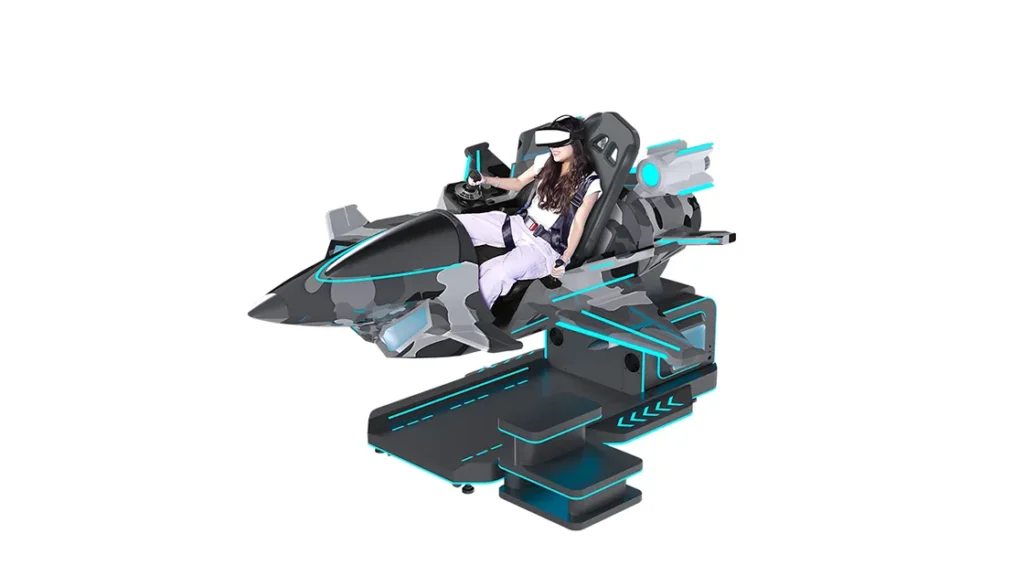
VR Flight Simulators
Flight simulators typically feature 360-degree rotating cockpits, prone positions (where the player lies face down), standing cockpits, and even simulators with more realistic fighter jet appearances, simulating piloting jet fighters, spaceships, or even riding on the back of a dragon.
9D VR Simulator
A staple of modern malls, “9D” refers to the integration of environmental effects. These capsule or egg-shaped theater seats combine 3-DOF (Degrees of Freedom) motion with wind, leg-ticklers, back-vibration, and scent effects to deliver a highly sensory movie or rollercoaster experience.
Free Roam VR
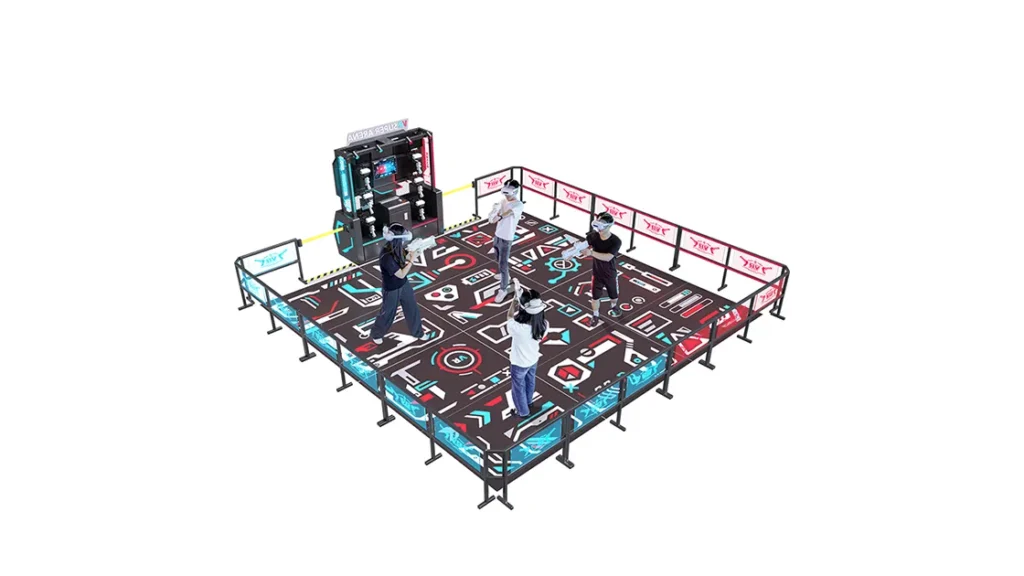
Free Roam VR is an immersive offline entertainment (LBE) system that emphasizes free roaming in large spaces. It allows players to move freely within a 5-10 meter square area in the real world, and through spatial positioning and wireless transmission technology, it perfectly synchronizes real-world walking, turning, and shooting actions to the virtual world. Compared to traditional seated VR, it offers unparalleled immersion and team interaction; some high-end experiences even incorporate physical mechanisms from escape rooms (such as bridges and elevators) to achieve a blend of virtual and real, making it the ultimate form of multiplayer cooperative shooting, zombie survival, and adventure exploration projects.
Best VR Arcade Machines for Different Business Needs
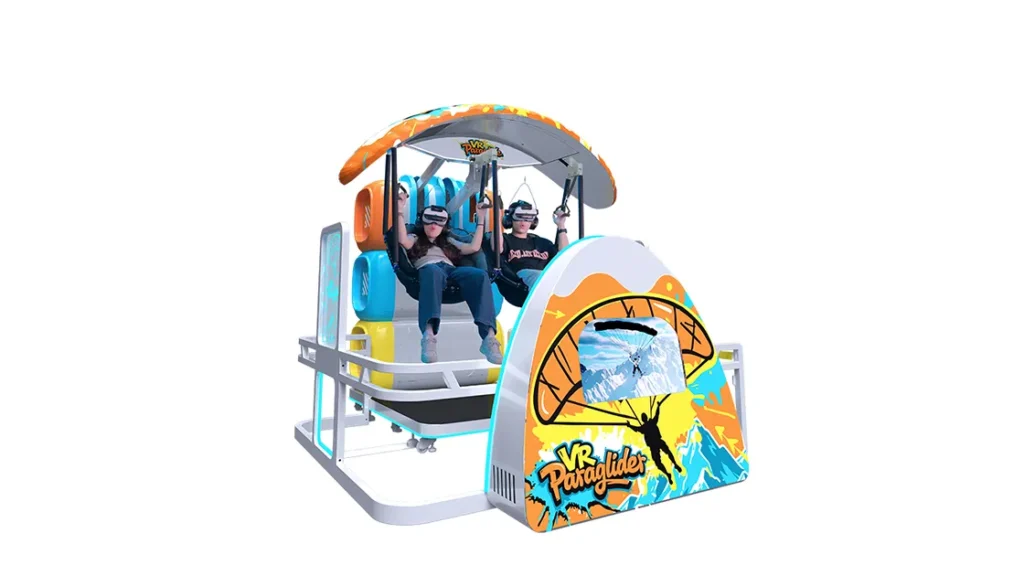
- Best High-ROI VR Machines: 360 VR chairs or VR paraglider. These vr theme park equipmentoffer low investment, small footprint, and high space efficiency, providing a strong immersive experience through 360° rotation and high-altitude ascents and descents, quickly attracting large crowds in offline settings. Their revenue model, supporting simultaneous two-person experiences, significantly shortens the return on investment cycle while lowering operational barriers, making them a highly cost-effective profit-generating solution.
- Best VR Machines for Small Spaces: 1-to-2 Player VR Egg Chair. Requiring less than 3㎡ of space, this compact powerhouse captivates crowds with thrilling roller coasters, deep-sea diving, and immersive sci-fi adventures that keep players thrilled and spectators hooked.
- Best Multiplayer VR Attractions: Free-Roam Shooting Arenas. Perfect for groups of 4 to 8 players, driving up ticket prices and fostering competitive team play.
- Best Family-Friendly VR Machines: 9D VR Cinema Simulator Gentle motion graphics, deep-sea exploration, and roller coaster simulations keep kids and parents entertained without intense violence.
- Best Premium VR Attractions: VR Space Ride. It is the pinnacle of 9D VR simulator Compared to ordinary equipment, it integrates multi-sensory effects such as heat, wind, fragrance, and water spray, achieving 100% realistic and immersive recreation of various film environments. To accommodate commercial spaces of different sizes, the vr amusement machine offers a variety of configurations from 2 to 8 seats. Despite its high initial cost, its strong eye-catching appeal and multi-person interactive experience have made it an indispensable core element for offline entertainment centers to create blockbuster projects and boost venue popularity.
How Profitable Are Virtual Reality Arcade Machine?
Key Revenue Drivers: Ticket Prices vs. Session Length
The sweet spot for VR arcade games is a 4 to 6-minute session length, with ticket prices ranging from $5 to $15 per play depending on your demographics. This ensures high throughput—a single seat can easily cycle 10 to 12 players per hour during peak times.
Analyzing the ROI: Average Payback Period for Operators
With steady weekend foot traffic, a standard 2-player VR simulator earning $200–$400 a day can hit full ROI (Return on Investment) within 3 to 6 months.
Upselling Strategies: Group Bookings, Parties, and Corporate Events
Do not rely solely on walk-ins. Package your multiplayer and free-roam VR attractions into VIP birthday party tiers and corporate team-building events. Charging a flat hourly fee for private access to the VR zone yields incredibly high profit margins.
Real-World Case Studies: Successful VR Theme Park Profit Models
Many mid-sized FECs report that after replacing three underperforming traditional arcade cabinets with one 4-player VR shooting attraction, their weekly revenue for that specific floor zone increased by over 150%, driven by repeat plays and spectator curiosity.
How Much Do VR Arcade Machines Cost?
Entry-Level vs. Premium VR Equipment Pricing
- Entry-Level ($3,000 – $8,000): virtual reality arcade machine for kids, VR egg chair or basic single-player VR racing simulators and VR shooting simulators.
- Mid-Tier ($8,000 – $20,000): 360 VR chair, Advanced multi-player VR racing simulators and VR shooting simulators, and 9D VR Cinema Simulator.
- Premium ($20,000 – $150,000+): Large-scale free-roam arenas and custom multi-player VR space ride.
Hidden Costs to Budget For: Shipping, Customs, and Installation
The price tag on the machine isn’t your final cost. Ensure you budget for:
- Ocean Freight & Local Logistics: Heavy motion platforms require specialized crating and lift-gate delivery.
- Import Duties & Customs Clearance: Varies drastically by country (tariffs can add 5% to 25% to the base cost).
- On-site Installation: Some suppliers include this, while others charge for technician travel and lodging.
How Much Space Do Virtual Reality Arcade Machines Need?
Small Footprint VR Game Machines
- Required Space: Around 2m²-3m².
- Best For: Kids virtual game machine / VR egg chair/ single-player VR racing simulators and VR shooting simulators/single-player VR 360 chair
Medium Footprint VR Game Machines
- Required Space: Around 3m²-20m².
- Best For: multi-player VR racing simulators and VR shooting simulators / 2 players VR 360 chair/multi-player 9D VR cinema simulator/VR Flight Simulators
Large Footprint VR Game Machines
- Required Space: Around 20m²-100m²+
- Best For: Free-Roam Arena / custom multi-player VR space ride.
How to Choose the Right VR Arcade Machine
When shopping for hardware, match your purchase to your specific business constraints across these four pillars:
1. Target Audience
- Malls & Tourist Spots: Opt for plug-and-play, family-friendly 9DVR simulators with high visual appeal.
- Hardcore Arcades / Bars: Lean into high-skill VR racing simulators or competitive shooters that encourage repeat play.
2. Venue Size
Do not overcrowd your floor. If space is tight, pick a high-throughput, small-footprint machine (like vr egg chair/single-player VR racing and VR shooting simulators) over a massive free-roam arena.
3. Budget & ROI
Balance your upfront capital against expected foot traffic. A premium $80,000 machine only makes sense if you have the massive weekend crowd numbers to amortize the cost quickly.
4. Single Player vs. Multiplayer VR Machines
Whenever budget allows, choose multiplayer. Group psychology dictates that friends want to experience things together. A 2-player or 4-player machine will almost always outperform a single-player station by more than double the revenue.
How to Choose a VR Arcade Machine Supplier
When shopping for hardware, match your purchase to your specific business constraints across these four pillars:
1. Manufacturer vs. Trading Company: Which is Right for You?
- Direct Manufacturers give you the lowest pricing, custom branding options, and immediate access to original engineering parts.
- Trading Companies might offer a wider variety of mixed commercial VR arcade machines, but they add a middleman markup and can complicate technical support. Aim for a direct manufacturer whenever possible.
2. Why Global Buyers Choose Commercial VR Arcade Machine Suppliers from China
China (Especially in science and technology centers like Panyu, Guangzhou) is the global epicenter for VR hardware manufacturing. Chinese suppliers offer unmatched cost-efficiencies, cutting-edge motion structural designs, and complete “turnkey” solution packages that Western distributors often just rebrand at twice the price.
3. Key Qualifications to Look For in a virtual reality arcade machine supplier
- Hardware Quality & Global Compliance Certificates: Ensure the supplier provides CE, RoHS, and UL certificates. Without these, you may fail local commercial safety inspections or face issues with business insurance.
- Game Library & Content Update Support: Ask how often they release new games. A machine with no software updates will see its revenue drop within a year as local players grow bored.
- After-Sales Service and Warranty Policy: Look for a minimum of a 1-year warranty on main hardware components and 24/7 online technical support to handle time-zone differences.
4. The Benefits of Working with a One-Stop VR Arcade Solution Provider
Top-tier suppliers don’t just sell you a box. They provide a VR Theme Park One-Stop Solution: 3D CAD layout planning for your venue, interior design suggestions, system integration, marketing materials, and full staff training.
5. Essential Questions to Ask a Supplier Before Placing an Order
- “Is the game software interface fully localized in my language?”
- “What specific brand of VR headset and PC components are used inside the machine?” (Insist on known brands like HTC, Pico, Intel, and Nvidia).
- “Do you provide real-time remote troubleshooting if a software glitch occurs?”
6. Red Flags to Watch Out For When Choosing a VR game machine Supplier
- Prices that are drastically lower than the market average (usually indicates refurbished PCs or low-grade tracking sensors).
- Vague or missing international compliance certifications.
- Lack of a dedicated software management platform for tracking earnings.
VR Arcade Machine Maintenance & Safety
1. Cleaning & Hygiene Protocols (Especially for VR Headsets)
Hygiene can make or break a VR arcade business.
- Use disposable fabric pads.
- Wipe down headsets with non-alcoholic, skin-safe antibacterial wipes between every single player session.
2. The Ultimate Daily & Weekly Maintenance Checklist
- Daily: Check the headset lens sharpness and viewpoint for any shifts, clean the face pad, test the audio channels, and confirm that all emergency stop buttons are functioning correctly.
- Weekly: Vacuum dust filters on the internal host PCs, check hydraulic/electrical motion joints for smooth articulation, and verify software update queues.
3. Common VR Machine Problems & Software Troubleshooting
- Issue: Screen flickering or tracking loss. Fix: Check for loose HDMI/DisplayPort or USB cables caused by the intense platform motion, or check for external light interference on tracking sensors.
- Issue: Motion platform lag. Fix: Reboot the control server and clear cache data in the arcade management software.
4. Player Safety Considerations & Physical Barriers
Always install clear, padded structural barriers around moving simulators. Ensure your staff checks that players meet age/height requirements and that seatbelts or safety harnesses are locked tight before hitting “Start.”
How to Start a VR Arcade Business
1. Location Planning
Target areas with high organic foot traffic: premium shopping centers, tourist boardwalks, or adjacent to busy movie theaters and traditional bowling alleys.
2. Market Research and Competitive Analysis
Identify who your local competitors are. If there’s an existing arcade nearby focused on retro gaming, that’s your cue to corner the market on high-end, immersive multi-player VR.
3. Startup Costs
An average small-to-mid-scale VR arcade business requires an initial investment ranging from $50,000 to $120,000, covering hardware, store lease deposits, interior design, and initial marketing runway.
4. Licensing, Insurance, and Legal Requirements
Obtain a standard commercial entertainment license. Crucially, secure a robust General Liability Insurance policy that explicitly covers active virtual reality simulator entertainment.
5. Machine Selection
Do not buy entirely one type of commercial vr arcade machine. Mix high-throughput entertainment pieces (like a VR parachute) with premium interactive systems (like a VR shooting game or vr racing game) to capture diverse customer interests.
6. Marketing Strategies
Leverage TikTok, Instagram Reels, and YouTube Shorts. Record raw spectator reactions—people screaming on a VR rollercoaster or intense multiplayer showdowns. Offer local school discounts, weekday birthday packages, and run local gaming tournaments to build a dedicated neighborhood community.
Conclusion
Investing in VR arcade machines is one of the most effective ways to future-proof an entertainment business. By combining high visual appeal, space-efficient footprints, and incredible replay value, these machines offer operators a fast track to profitability.
Success comes down to selecting a certified, reliable manufacturer, organizing an intentional layout that prioritizes player safety, and keeping your content fresh. Focus on these fundamentals, and your VR entertainment center will easily become the highest-earning attraction on your entertainment floor.
FAQs About VR Arcade Machines
A: Yes. Many small arcades, malls, and Family Entertainment Centers achieve fast ROI with compact VR simulators because they generate high revenue per square meter while requiring relatively low staffing costs.
A: Depending on foot traffic, ticket pricing, and machine type, most operators report an average ROI period of 3 to 12 months. Compact VR simulators often achieve faster returns due to lower upfront investment.
A: Small VR machines may require only 2–3㎡, while multiplayer simulators and free-roam VR arenas can require 20–100㎡ or more depending on the attraction type.
A: 9D VR simulators and VR egg chairs are popular in malls because they are visually attractive, compact, easy to operate, and suitable for a wide age range.
A: Yes. Many virtual reality arcade machines are specifically designed for kids and families, offering gentle motion experiences, cartoon-style content, and age-appropriate interactive games.
A: 9D VR focuses on seated motion simulation with environmental effects like wind and vibration, while Free Roam VR allows players to physically walk and interact inside a large tracked space.
A: Most commercial VR arcade machines come preloaded with 20–100+ games, depending on the machine category and supplier. Some manufacturers also provide regular game content updates.
A: Most 9d vr game machine can operate offline after installation. However, internet access may be required for software updates, multiplayer synchronization, or remote technical support.
A: Daily maintenance is relatively simple and mainly includes cleaning VR headsets, checking cables, testing motion systems, and updating software regularly.
A: Yes. Many manufacturers offer custom branding, machine colors, logo printing, localized software interfaces, and customized game packages for different markets.
A: Commercial VR game machines usually include emergency stop buttons, seat belts, safety harnesses, motion protection systems, and operator control panels to ensure player safety.
A: Key factors include product quality, CE/UL certifications, after-sales support, software update capability, spare parts availability, and experience in commercial entertainment projects.
A: Chinese manufacturers offer competitive pricing, advanced motion technology, diverse product categories, and complete VR theme park one-stop solutions for global entertainment businesses.
A: VR egg chairs, VR parachutes, and compact 360 VR simulators are often recommended for beginners because they require lower investment, minimal space, and simple operation.
A: Successful operators often use social media marketing, short-form videos, birthday party packages, group promotions, and multiplayer competitions to increase traffic and repeat visits.
Send Us A Message